
Lesson
Phishing & Scam Messages
Summary
Phishing isn't just about sketchy links — the best scams look like your bank, your school, or your best friend. This lesson breaks down the psychology behind phishing tactics and gives students concrete habits to verify before they click.
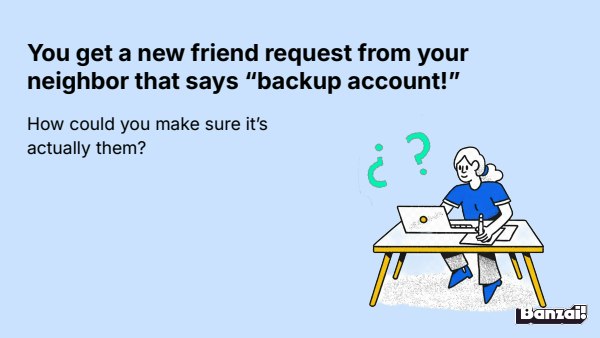
Bellringer: Spot the Mimic Account
- Display the friend request scenario
- Have students jot down how they'd verify a "backup account" claim
- Cold-call 2-3 students to share reasoning
Instruction
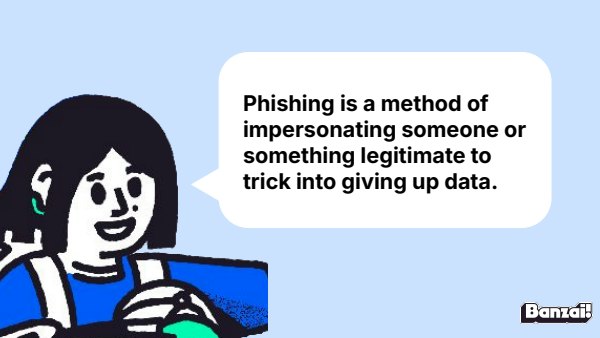
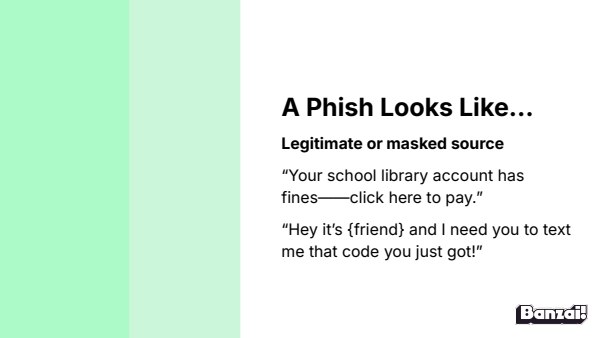
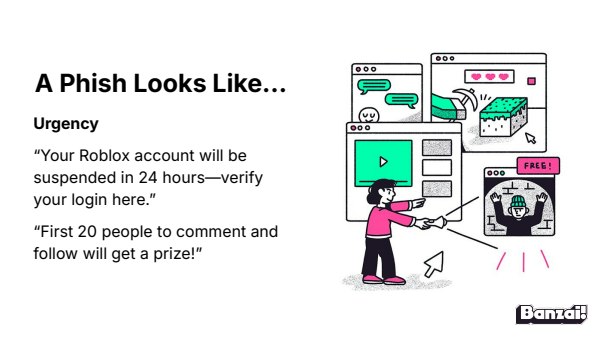
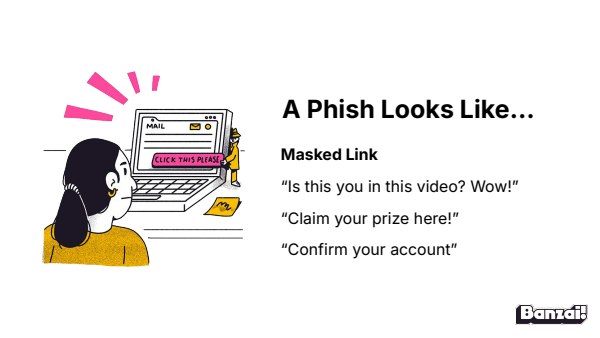
- Define phishing and walk through the three phishing patterns: trusted source, urgency, masked links
- Introduce the three defense habits — hover, verify, trust your gut
Discussion: Spotting the Red Flags
- Show paired real vs. fake messages side by side
- Ask students to identify which message is designed to panic them and why
- Discuss how scammers exploit personal details (pet names, hometowns) shared online
Activity: Clickbait & Phishing Worksheet
- Students complete the Clickbait & Phishing worksheet independently or in pairs
- Circulate to check that students can identify red flags in the sample phishing email
Wrap-Up & Assessment
- What's one strategy used by scammers?
- List 2 ways you can verify before clicking any links.
| Est. Time | Activity | Description |
|---|---|---|
| 5 min | Bellringer: Spot the Mimic Account |
|
| 10 min | Instruction |
|
| 10 min | Discussion: Spotting the Red Flags |
|
| 15 min | Activity: Clickbait & Phishing Worksheet |
|
| 5 min | Wrap-Up & Assessment |
|
Lesson Prep

Clickbait and Phishing
Students learn to spot clickbait and phishing tactics.
Class Presentation
Includes a 22-slide deck with teacher notes. Present from Banzai, download a PDF, or copy it to Google Slides.

Presentations, Ready to Go
- Built-in PresentationPresent full screen, straight from Banzai
- Copy to Google SlidesMake an editable copy for your class
- Download or PrintSave as a PDF or print
- Teacher NotesSlide-by-slide guidance, printable as one handout
Unit 2: Internet Safety

Password Protections
A social media bio might seem harmless, but it's basically a treasure map for password guessers. This lesson explores how oversharing online fuels social engineering, and teaches students to build stronger passphrases and use two-factor authentication.

Phishing & Scam Messages
Phishing isn't just about sketchy links — the best scams look like your bank, your school, or your best friend. This lesson breaks down the psychology behind phishing tactics and gives students concrete habits to verify before they click.

Online Shopping Scams
Forty-five dollars can feel like a steal — until you realize you just handed it to a criminal. This lesson breaks down the most common online scams targeting teens and gives students a concrete action plan for what to do when a deal turns into a theft.
How do Banzai lesson plans work? See the FAQ.